
Farm News Crop Forecast
U-Pick Recipes Nuts and Bolts
Greetings!
Wow it’s September again! We hope your fall transitions are going well.
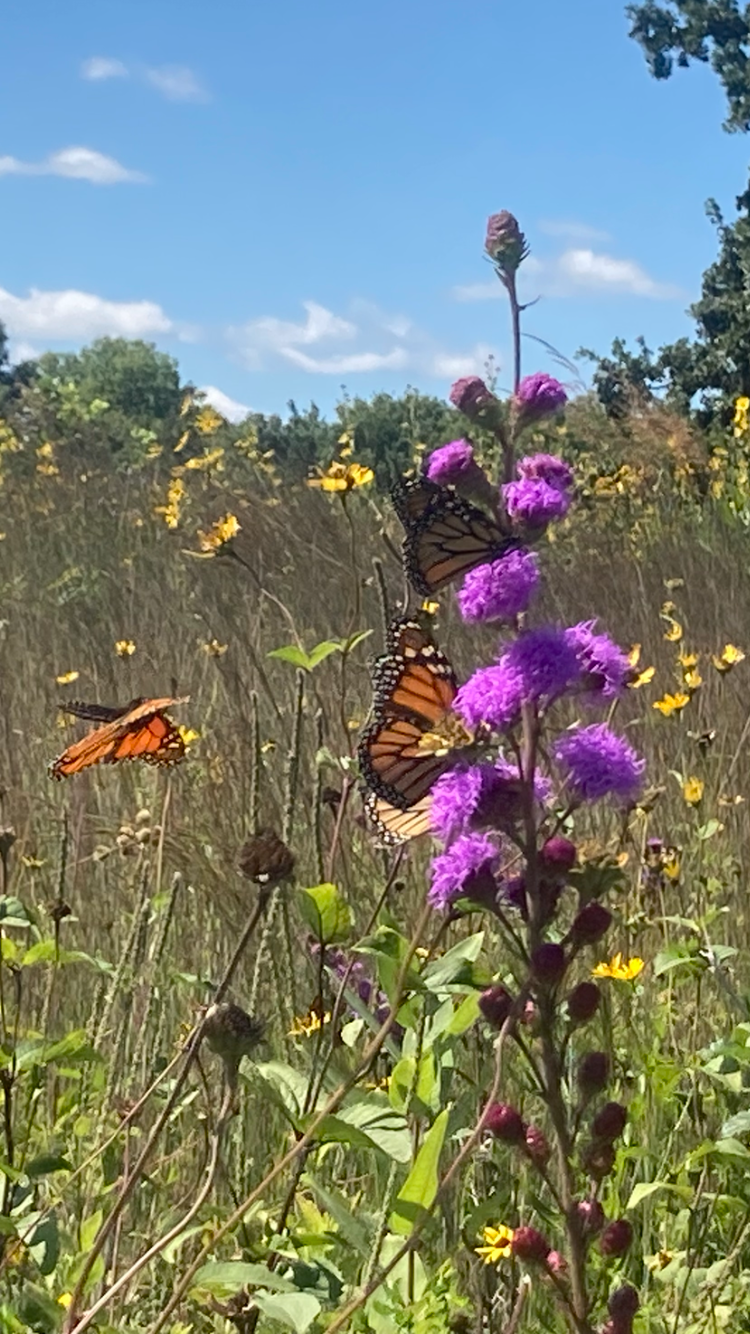
The amount of monarchs is amazing this year! The native flower above is blazing star, and many times in recent weeks we’ve seen 2-5 adult monarchs feeding on one plant.
We had a great visit with a seed breeder and seed farm manager, from our favorite seed company, Johnny’s Selected Seeds. They were on their way to a celebration at Seed Savers Exchange in Decorah, and we got to walk the fields with them for a couple hours. To us farmers it was like walking around with celebrities! Very down to earth and friendly celebrities.
First we said “let’s got to the pepper field, cuz that’s the ugliest place on the farm right now.” The plants actually look great from a distance — but they’ve got a bad case of bacterial leaf spot, which has caused them to lose leaves, flowers and fruit. Yields look like they’ll be 10-20% of normal, if we’re lucky.
We did all the same usual stuff and our usual sap testing and foliar feeding of deficient nutrients, but even that didn’t help them fight it off. We’ve heard that a lot of growers have the same disease and low yields this year. It’s been many years since we’ve had it, and we didn’t miss it!! It turned out that one of our guests, the breeder, was nicknamed “Dr. Pepper” — he had focused on peppers and shared a ton of nuances about pepper plants. Including that the main bell pepper variety that we grow is one of the best available, for size and consistency, and was one of the first peppers to have resistance to BLS bred into it, 30 years ago. But the bacteria has evolved, and our variety doesn’t have resistance to the newer strains.
This is where it got really interesting — he said he had spent 10 years trying to breed a pepper that got as big but also had resistance to the newer strains. But he and other teams of breeders just haven’t been able to do it — whenever they cross in the resistance, the fruit size goes down significantly.
It’s a reminder of the incredible unseen amount of effort, skill and knowledge that goes into our food. We depend on seed breeders and seed savers to cultivate varieties that work across different regions, soils, and pests. For us to do that work ourselves would be at least a full-time job, and our chances at outsmarting all the challenges are a lot less than the pros.
And every grower has a variety , or several varieties of different crops, that can’t be bought anywhere anymore. Maintaining the thousands of varieties that seed companies do is expensive, and sometimes our favorite ones are deemed no longer commercially viable, ie they dont’ sell enough to make it worth the cost to save and maintain it.
Spinach is our current hard luck story. One seed rep told us that there isn’t a good variety available right now that grows reliably on organic farms. We had one that worked for 10 years and then it stopped being available to buy. We’ll keep trying other ones … but in the meantime it’s another reminder that so, so much goes into this 3-meals-a-day thing!!
Crop Forecast
Tomatoes — they had a slow start but we are now in peak tomato time, this week and next. We expect they’ll slow down with the very cool nights in the forecast later this week, but there are still a lot on the plants, so they should go on for awhile. And if the forecast drops closer to fr-st, we’ll take the time to cover and protect them.
Melons! Cantaloupes came and went a little quicker than usual, hopefully you had a chance or two at them. Probably no cantalopes this week. We’re almost out of yellow watermelon and smaller reds, so this week will mostly be the big, very sweet, pink ones, called Crimson Sweet (Erin’s favorite). If we’re lucky we’ll have them next week too.
Peppers – we may finally have a normal amount of peppers in the share this week, including some red Carmens. Normally we have many bushels to choose from and to fill out the share table , while summer squash and cucumbers slow down. If the peppers don’t add up to quite enough, we may have to lower the bag size for a week or two. Hot peppers – we’ll start with one next week and go as long as we can, there are some late ones hanging on and sizing up.
More summertime this week and next : this last week or two of cucumbers, summer squash and zucchini we may need to have a limit on them; plus storage onions, eggplants, carrots, beets, cauliflower, fennel, cabbage, leeks and celery. Shallots for a week or two! (Use shallots similarly to onions but they’re much sweeter and can be highlighted more, and make anything sweeter.) Broccoli is still struggling and hopefully we’ll have more in a few weeks.
Leaf lettuce and greens and kale are having a great year. We normally have spinach by now, but it’s sick and barely growing so maybe a little bit next week.
Garlic for 2 more weeks in the share, then it’ll continue to be for sale in the barn.
For Winter Squash, we may have spaghetti squash next week, and delicata and acorn in 1-2 weeks. We try hard to only put out ones that are fully cured — ie fully matured and developed in flavor. Buttercup, ambercup and butternut should be ready in 2-3 weeks.
We grow pumpkins too early….they really should be planted a few weeks after winter squash , but we do so many things and so many plantings we just start the pumpkins at the same time as squash. So we have orange pumpkins already! They’ll be available in front of the barn sometime in the next 2-3 weeks.
Also Radishes this week — watermelon radish this week, plus pink and purple (and green!) Daikon in the coming weeks. This week or next we might have a small showing of Napa cabbage and Kohlrabi too. Celeriac (celery root) later in the month, it’s still small.
Can’t believe we’re talking about fall veggies!!!!!
What’s for U-Pick?
Cherry Tomatoes — If any have split from the rain, they can still be eaten, until the split/crack starts looking fuzzy white with invaders. Hopefully more tomatoes and ground cherries will ripen so we can raise the limit. Please check the Upick board before picking.
Beans still going for awhile!
Sunflowers! Out toward the solar panels. They are starting to slow down but you can still find some out there. It’s a good idea to bring your own pair of clippers.
Cilantro, Dill and Basil are doing great!
Other Herbs — Thai Basil, Nasturtiums, Parsley, Oregano, Thyme.
Flowers look great but some will go downhill as it gets cooler and later in the fall. There are two plantings, one on each side of the driveway.
This spot in the newsletter will keep you informed, and always check the U-pick board when you’re here to see what’s available and picking amounts.
Nuts and Bolts
Bulk Produce for You
Check here each newsletter for what we have available for extra purchase.
To place a bulk order, simply email us at least 2 days ahead of the day you’d like to pick it up. Orders can be picked up at the farm during our regular pickup hours, but it doesn’t have to be your share pickup day. Usually we can make an order on the spot, too. No need to pre-order garlic.
This week’s selection is : Green Cabbage for $1/lb. Kale for $3 / lb. Carrots, Beets for $1.25 / lb. Basil for $9 / lb. Garlic for $1.25 / head. Large Red watermelon $1 lb (range of 8-20 lb). Leeks for $3 / lb (probably about $1 each). Storage Onions starting next week for $1.25/ lb.
From Maura and LuAnn in the Medicinal Herbs Garden
Make It and Take It Fire Cider Activity
It’s the season to make fire cider at Open Hands Farm by the medicinal herbs garden! Craft your own quart(s) of fire cider using provided veggies from the farm along with fresh, vibrant herbs from the medicinal herbs garden, specific to your tastes and needs. All you bring along is a cutting board and a sharp knife for slicing onions, peppers, and other veggies. Your handcrafted fire cider will be ready to support your health through the coming months (as well as spicing up your salads in place of plain vinegar). To learn more about fire cider, check out this page of my website.
There will be two identical sessions offered during CSA share pick-up times:
Thursday, September 4: Come anytime between 1:30 – 5:00 p.m
Tuesday, September 9: Come anytime between 1:30 – 5:00 p.m.
The cost is $30 per quart, payable at the activity.
Please be sure to RSVP to 507.581.4185
Share Pickup Hours TUESDAY and THURSDAY 1:30-6:30 pm.
Change Pick-Up Day Form — Click here. Please fill out this form instead of emailing us. Thanks!
Where is the farm? 4151 320th Street West, Northfield.
Please Drive Carefully —Children are everywhere.
If You Send Someone Else to Pick Up Your Share — Please forward them the basic pickup video in this link , which was also sent in an email earlier in June. Then just tell them to introduce themselves to us in the barn, just so we know and we can show them around.
We love having all of you come to the farm! Thank you for making it such a great place to be!
Your farmers,
Erin and Ben, with Allia, Alex, Camille, Elliott, Maura, River, Sai Dang and Crew
RECIPES
Rolled Stuffed Salmon
3 tablespoons unsalted butter
2 large leeks (white and pale-green parts only) chopped and washed well (3 ¼ cups) — you could use sweet onions too!
1 bunch Swiss chard, tough stems trimmed, leaves chopped (6 cups)
Coarse salt and freshly ground pepper
½ cup plain Greek yogurt
2 tablespoons lemon juice
1 tablespoon whole-grain mustard
1 tablespoon Dijon mustard
2 teaspoons minced garlic
2 teaspoons soy sauce
2 ¼ pounds salmon fillet, skin removed
¼ cup packed dill sprigs, plus 6 more sprigs for tops
Extra-virgin olive oil
Preheat oven to 450 degrees F.
Melt butter in a large skillet over high.
Add leeks; cook, stirring, until just golden, about 4 minutes.
Add chard; season with salt and pepper.
Cook, tossing, until wilted, about 3 minutes. Let cool.
In a small bowl, whisk together yogurt, lemon juice, mustards, garlic, and soy sauce.
Butterfly salmon by cutting horizontally through middle along one long side, leaving other side intact. Open flat, like a book. Flip salmon, skinned-side up; season with salt and pepper.
Spread top with ¼ cup yogurt mixture.
Top with dill sprigs, then chard mixture.
With a long side facing you, roll up salmon into a tight log. Secure with 6 pieces of kitchen twine, starting about 1 ¼ inches from end and spacing evenly.
Cut salmon into 6 equal pieces, slicing between twine.
Tuck a dill sprig under twine on each roll.
Place rolls in a baking dish and drizzle with oil, rubbing to coat.
Season with salt and pepper.
Roast until salmon is opaque on outside but still pink inside, about 15 minutes.
Serve, with remaining yogurt mixture alongside.
Tomato Basil Salad with Shaved Parmesan and Balsamic Reduction
1 cup balsamic vinegar
2 tsp honey
¼ teaspoon minced garlic
¼ teaspoon minced shallot
1 small sprig fresh rosemary
4 medium tomatoes, cored, cut crosswise into ½ inch slices
8 large fresh basil leaves, sliced very finely
Salt
Freshly ground black pepper
Red onion, to taste, sliced as thinly as possible
1-2 ounces Parmesan cheese, very thinly sliced
¼ cup extra virgin olive oil or more to taste
Put the balsamic vinegar in a stainless steel or ceramic-coated pot over medium-high heat. Add the honey, garlic, shallot, and rosemary sprig.
Bring the ingredients to a boil, then reduce to a simmer.
Gently simmer the mixture, uncovered, until it has reduced to about 1/3 cup and is the consistency of syrup, about 20 minutes.
Remove the pot from the stove and set it aside to cool. Strain if desired.
Arrange the tomato slices on individual plates. Scatter the basil evenly over the tomatoes. Season with salt and pepper to taste. Sprinkle with onion to taste.
Drizzle 1½ teaspoon of the balsamic reduction over each serving. (Don’t drench the plates; the reduction is concentrated and very flavorful—a little goes a long way.)
Top each serving with Parmesan slices and drizzle with about 1 tablespoon oil, or more if you desire.
Serve immediately.
 Open Hands Farm