Farm News Crop Forecast
U-Pick Recipes Nuts and Bolts
Greetings!
Oofda!
By the time you read this, the heat wave should be behind us, but wowie. That was a doozy! As you know the extra humidity really cranked up the heat index, and a full week of that much heat is a bit of a marathon. Our great crew pushed through to keep the food rolling!
We are grateful that we went into it with some moisture in the ground — the week before had been drizzly (too often) and had left us with 2″ over several days and showers. The frequency made it hard to kill weeds, so we got behind a little. Then the heat made it easy to kill weeds — but we had to take more breaks and then the smoke meant a half day off, so the weeds got another chance to pull away from us. We’re close and we’ll get them though!
At this point most of the veggie plants are too big to drive tractors over, so we’re into more hand weeding. Now it’s mostly about preventing them from going to seed and creating work in future years. “1 year seeding is 7 years weeding,” the saying goes, since the plants we typically call “weeds” have earned the designation in part because they make many thousands to millions of seeds per plant (compared to the hundreds to low thousands made by a pepper plant, for example). Some of what we’re pulling would decrease yields of the vegetables they’re sharing space with, but most wouldn’t. They would make harvest more difficult and less efficient though. So if we make a push now we’ll thank ourselves in September, and in future years.
We do think we have fewer weeds germinating each year than we used to. The group of troublesome species has certainly changed — we don’t see nutsedge, wild mustard or pennycress much or at all anymore, though we still have foxtail grass, lambsquarters, amaranth and buttonweed. Purslane didn’t become widespread in our fields until the last few years, and is now the most difficult among them. Primarily because once it is too big to be buried by cultivating tools on tractors — which only takes 7-10 days from germination — it can reroot in the field no matter what we do to it, then carry on with vigorous growth to compete with the veggies. We’ve gotten very good at burying it — but when it’s the same size as, say, the carrot it’s snuggled up to, we can’t bury it without burying the carrot.
We have a big test of purslane durability underway right now — last Monday we weeded an acre of carrots which had a lot of purslane, and left it to dry in last week’s heat, without irrigation. It dried out, but it is a very succulent plant, and did not shrivel fully like the grasses and broadleaves.
Purslane is edible of course, though the wild version like we have isn’t as flavorful as ones that have been bred for better flavor. And harvesting it is not easy, unless it gets so big that it will soon drop millions of seeds for future years. For us, preventing losses from it is a big job but it’s job security too!
One of the ironies of purslane is that it’s a sign of good fertility in vegetable soils. Vegetables require a lot of nutrients, to be healthy in their own life cycle in order to provide nutrient dense food for you. Purslane thrives with that high fertility, adding to the conundrum of how to manage it. Fortunately we’ve so far avoided or are having a reprieve from others on the list of most difficult weeds, but the ones we have keep us moving all summer long! Harvest takes up most of our time from now on, but we”ll be weeding most of any hours that we’re not harvesting!
Crop Forecast
On a scale of storms to break an intense heat wave, we got a pretty mild one. We had a moderately intense half inch, then almost 2 hours later we had a hard and blowing half inch. We’re grateful it wasn’t harder, or ice balls. We have some carrots ready for harvest – which we didn’t get to due to the smoke last week — and some of those might have split a little from drinking too much at once. But otherwise the fields and crops look to have done fine through Monday’s rains.
Sweet Onions! It seems a humble veggie to get so excited about but they really take any dish to a new level, raw or cooked. We’ll have plenty of them plus a few tomatoes — this is just the beginning for them, hopefully they’ll crescendo into late August and keep giving through September and into October. The plants look great and have good amounts of fruit and flowers on them. Our eggplants got off to a rough start during the cool stretch in June and didn’t set much fruit. There are lots of flowers on the plants now though, so we will enjoy a lot of them in August!
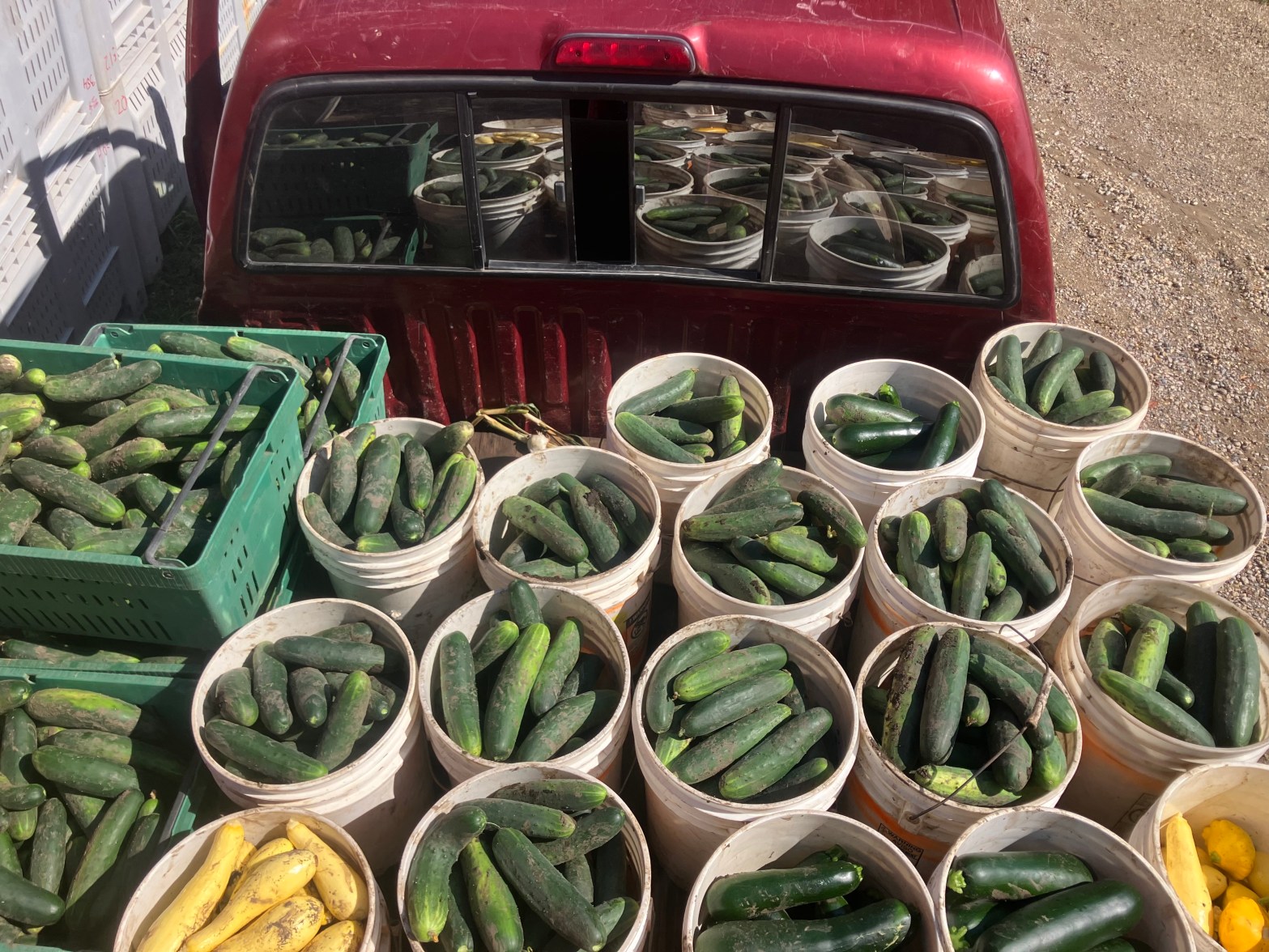
We continue to have : broccoli, summer squash and zucchini, cucumbers, carrots, beets, cabbage, fennel, scallions, and kohlrabi. Plus leaf lettuce, salad greens, garlic scapes, kale, boc choi and chard.
We’ve had a lot of boc choi but will reach its end soon. We planted extra, plus some Broccolini, hoping to have it replace broccoli in August, which often struggles with disease (sick leaves, brown spots on the heads, etc). But we got the timing wrong and the boc choi came in early (right on the heels of our spring planting) and now the broccolini just all came in. We’ll plant them later next year, lesson learned! For now there’s the mix of all 3 ! In August, when the current broccoli planting runs out in a few weeks, we’ll wish we had some boc choi and broccolini to sub in, but there should be plenty of other good things to eat then anyway and maybe we won’t notice.
Watermelons and cantaloupe look very good, though it’s hard to know now for sure how many fruits they’re hiding under those vines, since most of the fruits are still marble-size to tennis ball-size. We usually start having them in the share the first or second week of August, for 4-5 weeks.
What’s for U-Pick?
Beans are here for the rest of summer, pick and pick some more! If you ever walk into a row and can’t find any — just keep walking , most people stay close to the ends, even with the flag system. The more they’re picked, the more they’ll produce. We have plenty of people who freeze and/or can beans, or just eat a whole mess fresh. And it’s ok with us if some go by — we over-plant a little to make sure there are plenty at all times in the summer. They’re super cheap to plant and grow — harvest is the expensive part — so we figure the continued abundance is worth a little loss of ones gone by.
Basil, Dill, Cilantro (near solar panels) — all unlimited, with more plantings coming thru fall.
Other Herbs (near beans) — Nasturtium (edible flowers with a kick), sage, curly parsley, flat parsley, oregano, thyme, anise hyssop — are all unlimited too.
Flowers — lots on the west side of driveway (opposite side from parked cars) and this week we’ll open a second planting east of the driveway (same side as parked cars). The sunflowers are coming too, this week or next.
Cherry tomatoes should start to trickle in next week, with a small amount per share. Then we normally get to an abundance of them too in peak season. The plants are looking good.
This spot in the newsletter will keep you informed, and always check the U-pick board when you’re here to see what’s available and picking amounts.
Nuts and Bolts
OHF T-Shirts for Sale in the Barn! $15 each. We re-ordered the more popular designs and sizes, and added in xtra-small adult and kid’s sizes! Printed by Larson’s Printing downtown.
Bulk Produce for You
Check here each newsletter for what we have available for extra purchase.
To place a bulk order, simply email us at least 2 days ahead of the day you’d like to pick it up. Orders can be picked up at the farm during our regular pickup hours, but it doesn’t have to be your share pickup day. Usually we can make an order on the spot, too.
This week’s bulk selection is : Carrots, Beets, Cukes, zukes and squash for $1.50 / lb, Lettuce Mix for $6 / lb. Kale and chard for $3 / lb, cabbage for $1/lb.
Share Pickup Hours TUESDAY and THURSDAY 1:30-6:30 pm.
Change Pick-Up Day Form — Click here. Please fill out this form instead of emailing us. Thanks!
Where is the farm? 4151 320th Street West, Northfield.
Please Drive Carefully —Children are everywhere.
If You Send Someone Else to Pick Up Your Share — Please forward them the basic pickup video in this link , which was also sent in an email earlier in June. Then just tell them to introduce themselves to us in the barn, just so we know and we can show them around.
We love having all of you come to the farm! Thank you for making it such a great place to be!
Your farmers,
Erin and Ben, with Allia, Alex, Camille, River, Soli, Elliott, Sahara, Sai Dang and crew
RECIPES
Roasted Kohlrabi
4 kohlrabi bulbs, peeled
1 tablespoon olive oil
1 clove garlic, minced
Salt and pepper to taste
⅓ cup grated Parmesan cheese
Preheat an oven to 450 degrees F.
Cut the kohlrabi into 1/4 inch thick slices, then cut each of the slices in half.
Combine olive oil, garlic, salt and pepper in a large bowl.
Toss kohlrabi slices in the olive oil mixture to coat.
Spread kohlrabi in a single layer on a baking sheet.
Bake in the preheated oven until browned, 15 to 20 minutes, stirring occasionally in order to brown evenly.
Remove from the oven and sprinkle with Parmesan cheese.
Return to the oven to allow the Parmesan cheese to brown, about 5 minutes.
Serve immediately.
Sesame Noodle Salad with Cucumbers
16 ounces spaghetti, broken into thirds
4 Tablespoons soy sauce
3 tablespoons vegetable oil or light olive oil
6 tablespoons lime juice
Dash of Cayenne
3 cucumbers, seeded and thinly sliced
2 carrots, grated; or 6 radishes, thinly sliced (optional)
3 green onions, minced
3 tablespoons finely chopped fresh cilantro
3 tablespoons toasted sesame seeds
Cook the pasta according to the package directions, drain, rinse with cold water, and set aside.
Meanwhile, prepare a dressing by whisking together the soy sauce, oils, lime juice, and cayenne.
When the noodles are cool, toss with the dressing to coat.
Stir in the cucumbers, additional vegetables (if desired), green onions, cilantro, and sesame seeds.
Serve this Asian-inspired salad alone or as a bed for marinated, grilled chicken thighs or flank steak.

